
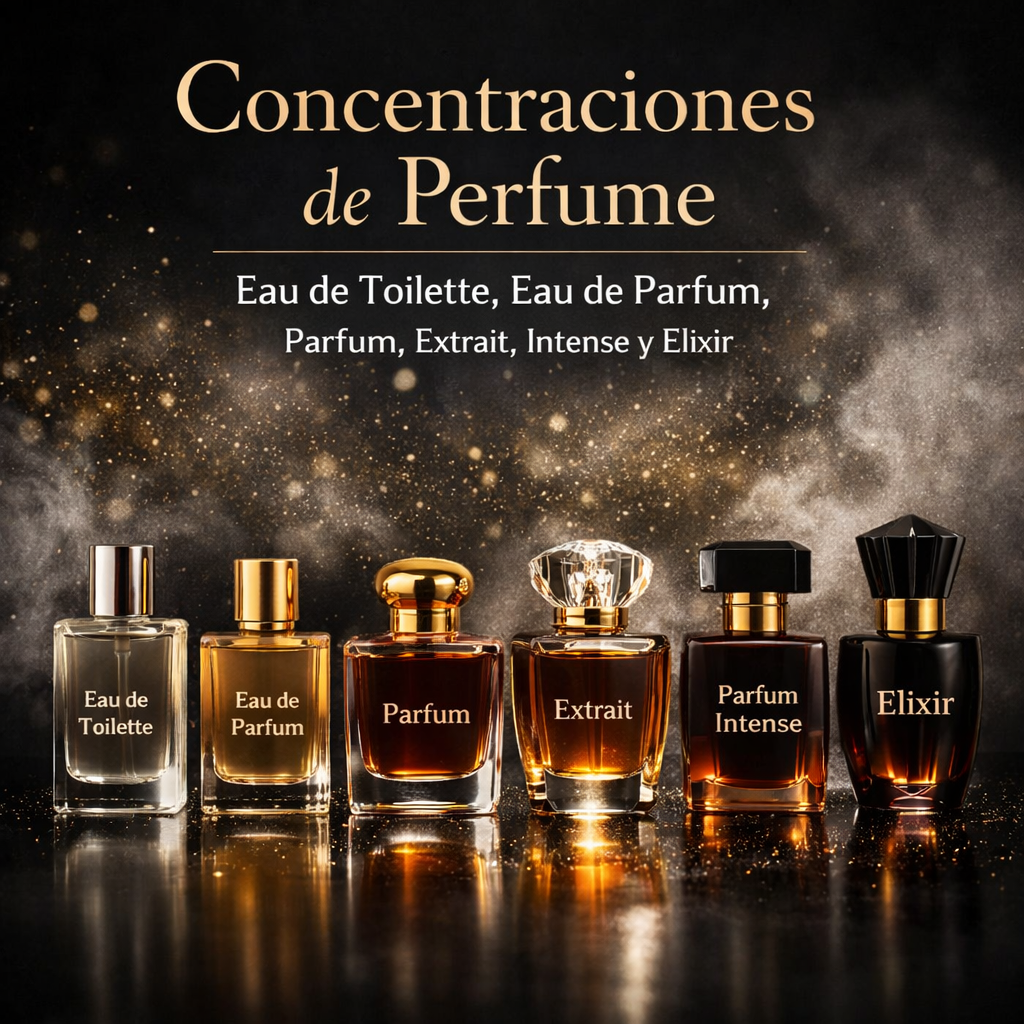
When choosing a fragrance, most people focus on the notes, the bottle, or the impression it leaves on skin. But there is another factor that shapes the experience just as much — and is often misunderstood: concentration.
Terms such as Eau de Toilette, Eau de Parfum, Parfum, Extrait de Parfum, Parfum Intense, and Elixir do not simply suggest that a fragrance is lighter or stronger. In most cases, they refer to the approximate percentage of aromatic compounds within the formula. In general, the higher the concentration, the richer, deeper, and more long-lasting a fragrance may feel. That said, performance also depends on the structure of the composition, the materials used, and how the fragrance behaves on skin.
That is where an important nuance comes in: these categories are useful guides, not rigid universal laws. Not every brand works in exactly the same way, and terms such as Intense or Elixir are not consistently standardized across the industry. Sometimes they refer to concentration; sometimes they also signal olfactive character, depth, and positioning within a fragrance line.
Perfume concentration chart
| Type | Approximate concentration | Typical feel |
|---|---|---|
| Eau de Toilette (EDT) | 5%–15% | Fresher, lighter, more transparent |
| Eau de Parfum (EDP) | 15%–20% | More rounded, balanced, and versatile |
| Parfum | 20%–30% | Richer, denser, more enveloping |
| Extrait de Parfum | 20%–40% | Highly concentrated, deep, and luxurious |
| Parfum Intense* | 15%–40% | More body, more depth, and stronger persistence |
| Elixir* | Variable high range | Usually presented as the most intense or concentrated version |
* Parfum Intense and Elixir are not universally standardized categories. Their actual range may vary depending on the brand and the formula.
Eau de Toilette: the lightest and freshest concentration
Eau de Toilette usually falls within an approximate range of 5% to 15%. It typically feels lighter, fresher, and more immediate, with a brighter opening and a more transparent evolution on skin.
That does not make it inferior or less refined. It simply serves a different purpose. An Eau de Toilette can be ideal for those who prefer a more airy fragrance, something easy to wear, and especially comfortable in warm weather or during the day.
Eau de Parfum: balance between presence and versatility
Eau de Parfum generally sits around 15% to 20% and remains one of the most popular concentrations in perfumery. The reason is simple: it tends to offer a strong balance between longevity, body, and versatility.
Compared to an Eau de Toilette, an Eau de Parfum often feels more rounded, with greater depth and a more consistent development, without necessarily reaching the density of a Parfum or an Extrait.
Parfum: more density, more depth, more signature
Parfum usually falls within an approximate range of 20% to 30%. It is often perceived as a richer, more polished, and more concentrated expression of a fragrance, with greater emphasis on the heart and base.
That said, more concentration does not always mean more volume. In fact, some parfums project less aggressively than other versions, but leave a deeper, more elegant, and longer-lasting trail closer to the skin.
Extrait de Parfum: the richest and most enveloping concentration
Extrait de Parfum is commonly associated with one of the highest concentration levels in perfumery, often within a range of 20% to 40%. For that reason, it is usually linked to fragrances that feel more opulent, dense, and enveloping.
Still, it is worth avoiding simplistic conclusions. An Extrait de Parfum is not automatically better than an Eau de Parfum. Some compositions perform more beautifully in a lighter structure, while others gain far more personality and depth when formulated at a higher concentration.
Parfum Intense: more than a matter of percentage
The category Parfum Intense is especially interesting because it does not follow a single fixed standard. It can sit in a space that overlaps with powerful Eau de Parfums, certain Parfums, and even formulas close to Extrait territory.
But the key point here is not just percentage. It is olfactive intention.
A Parfum Intense is usually conceived as a fragrance with greater density, more depth, and a more pronounced presence. It is not only meant to last longer. It is meant to feel fuller, more textured, and more memorable. It often leans into a construction with more body, more character, and a deeper evolution on skin.
That is why, when a fragrance is presented as Parfum Intense, it usually communicates more than strength. It suggests presence, character, and an olfactive signature designed to leave an impression.
Parfum Intense for Men
Elixir: an even more intense interpretation
With Elixir, the same logic applies — often even more strongly. Many brands use the term to present the richest, deepest, most sensual, or most intense interpretation within a fragrance line. It usually belongs to the upper end of the concentration spectrum and often sits close to the world of Parfum or Extrait, but it does not correspond to one fixed technical category.
For that reason, when you see Elixir on a bottle, the most sensible way to read it is as a promise of greater richness and intensity, not as a rigid technical definition.
Does higher concentration mean a better perfume?
Not necessarily.
A higher concentration can bring more depth, longer wear, and a more enveloping feel, but that does not automatically make a fragrance superior. The final result also depends on the formula itself, the balance of raw materials, and the way the composition behaves on skin.
Concentration matters, yes. But it is not a simple ranking from “less good” to “better.” More than anything, it is a matter of intention, character, and balance.
Which perfume concentration should you choose?
The best concentration depends on what you want from a fragrance:
- Eau de Toilette: if you prefer freshness, lightness, and ease of wear.
- Eau de Parfum: if you want balance between presence and versatility.
- Parfum or Extrait de Parfum: if you want more richness, more depth, and a more enveloping feel.
- Parfum Intense or Elixir: if you are drawn to fragrances with more body, more character, and a more pronounced presence.
Conclusion
Concentration is one of the most important — and most misunderstood — aspects of perfumery.
Yes, it influences longevity, density, and the way a fragrance develops on skin. But on its own, it does not define quality. What truly matters is how concentration, formula, and character work together to create a coherent olfactive experience.
That is the point where perfumery stops being purely technical and becomes something memorable.

Within that logic, ROCKETMEN is presented as a Parfum Intense: an interpretation designed to offer depth, presence, and character. It is not simply about intensity. It is about leaving a real impression.
Discover ROCKETMEN on the product page.
